Nostalgic Handheld Game
It's dangerous to golf alone, take this! ꒰˘̩̩̩⌣˘̩̩̩꒱♡
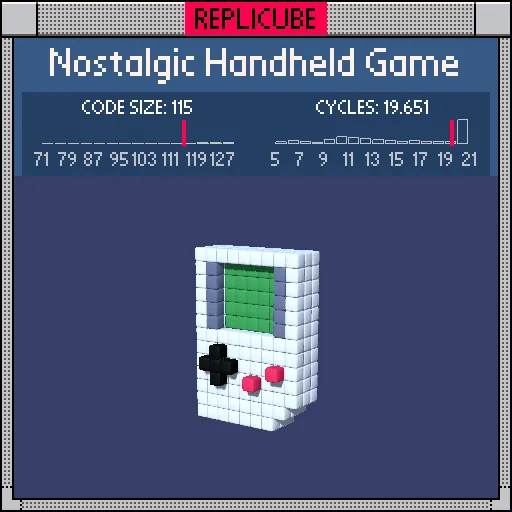
| Grid | Code Size | Leaderboard | Cycles | Leaderboard | Date |
|---|---|---|---|---|---|
| 13x13x13 | 115 | #313 | 19.651 | #3052 | 2026-02-23 |
Solution
a=abs(x)b=abs(y-3)
return z==2 and(abs(x+2)+abs(y+2)<2 and 3 or(x==3 and y==-2 or x==1 and y==-3)and 7)or a<3 and b<3 and(z==0 and 11 or z==1 and 0)or z==1 and a<4 and b<3 and 2 or z*z<4 and a<5 and(x<4 or y>-5)and(y>-6 or x<3)
How it works
A tiny Game Boy, built layer by layer from front to back!
The front face (z=2) has all the interactive bits. The d-pad is a cross shape centered at (-2,-2), and Manhattan distance does the heavy lifting: abs(x+2)+abs(y+2)<2 carves out the plus shape in one shot. The A and B buttons are two lone red voxels.
The screen lives at z=0 in green, with a grey frame around it at z=1. The tricky part is the screen hole: at z=1 inside the screen area, there should be nothing (you’re looking through to the green screen behind). We handle this with z==1 and 0, which returns a falsy value that blocks the body from filling in that spot.
The body is the white shell, a flat slab at z=-1,0,1 with a notched corner at the bottom-right. Two or conditions carve out the notch by excluding voxels where x and y are both too far into that corner.
Everything chains together in priority order: controls first, then screen, then frame, then body. Each layer claims its voxels before the next one gets a chance.